Hallo,
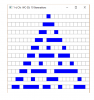
ich habe ein mehrdimensionales Array bestehend aus 0 und 1 und möchte in JavaFX dann dazu eine Grafik basteln.
Habe die Grundstruktur von meinem Prof bekommen(siehe Bild). Nun möchte ich das bei jeder 1 ein Feld blau markiert wird. Meine Heransgehensweise war das Mehrdimensionale Array durchzulaufen und mittels if-Abfrage dann das Feld zu bepinseln.
Nur bekomme ich so ganz viele Exceptions:
Das ist die Schleife:
Ich habe bisjetzt noch nie mit JavaFX gearbeitet, von dem her wird die Lösung wahrscheinlich recht simpel sein.
Hier noch die Exceptions:
Exception in Application start method
java.lang.reflect.InvocationTargetException
at sun.reflect.NativeMethodAccessorImpl.invoke0(Native Method)
at sun.reflect.NativeMethodAccessorImpl.invoke(Unknown Source)
at sun.reflect.DelegatingMethodAccessorImpl.invoke(Unknown Source)
at java.lang.reflect.Method.invoke(Unknown Source)
at com.sun.javafx.application.LauncherImpl.launchApplicationWithArgs(LauncherImpl.java:389)
at com.sun.javafx.application.LauncherImpl.launchApplication(LauncherImpl.java:328)
at sun.reflect.NativeMethodAccessorImpl.invoke0(Native Method)
at sun.reflect.NativeMethodAccessorImpl.invoke(Unknown Source)
at sun.reflect.DelegatingMethodAccessorImpl.invoke(Unknown Source)
at java.lang.reflect.Method.invoke(Unknown Source)
at sun.launcher.LauncherHelper$FXHelper.main(Unknown Source)
Caused by: java.lang.RuntimeException: Exception in Application start method
at com.sun.javafx.application.LauncherImpl.launchApplication1(LauncherImpl.java:917)
at com.sun.javafx.application.LauncherImpl.lambda$launchApplication$154(LauncherImpl.java:182)
at java.lang.Thread.run(Unknown Source)
Caused by: java.lang.NullPointerException
at CA1.start(CA1.java:92)
at com.sun.javafx.application.LauncherImpl.lambda$launchApplication1$161(LauncherImpl.java:863)
at com.sun.javafx.application.PlatformImpl.lambda$runAndWait$174(PlatformImpl.java:326)
at com.sun.javafx.application.PlatformImpl.lambda$null$172(PlatformImpl.java:295)
at java.security.AccessController.doPrivileged(Native Method)
at com.sun.javafx.application.PlatformImpl.lambda$runLater$173(PlatformImpl.java:294)
at com.sun.glass.ui.InvokeLaterDispatcher$Future.run(InvokeLaterDispatcher.java:95)
at com.sun.glass.ui.win.WinApplication._runLoop(Native Method)
at com.sun.glass.ui.win.WinApplication.lambda$null$147(WinApplication.java:177)
... 1 more
Exception running application CA1
ich habe ein mehrdimensionales Array bestehend aus 0 und 1 und möchte in JavaFX dann dazu eine Grafik basteln.
Habe die Grundstruktur von meinem Prof bekommen(siehe Bild). Nun möchte ich das bei jeder 1 ein Feld blau markiert wird. Meine Heransgehensweise war das Mehrdimensionale Array durchzulaufen und mittels if-Abfrage dann das Feld zu bepinseln.
Nur bekomme ich so ganz viele Exceptions:
Java:
// Given a Wolfram Code (eg WC 90, 0 <= WC <= 255) of a 1-d cellular automaton and the number of generations,
// generate and display the resulting configurations.
// Use JavaFX to graphically display the configurations.

import javafx.application.Application;
import javafx.scene.Scene;
import javafx.scene.Group;
import javafx.scene.paint.Color;
import javafx.stage.Stage;
import javafx.scene.canvas.Canvas;
import javafx.scene.canvas.GraphicsContext;

public class CA1 extends Application  // class CA MUST NOT have a constructor (else java.lang.reflect.InvocationTargetException)
{
    public static final int WC = 30;  // Wolfram Code for 1-d cellular automata
    public static final int GENS = 10;  // number of generations
    public static final int range = 2 * GENS + 1;


    public static final int SF = 20;  // scale factor: 1 cell = SF*SF pixels

    static int[][] cell ;  // global variable for communication with start(stage) method

    //*****************************************************************************************
    public static void main(String[] args)
    {
        System.out.println("WC-" + WC + ", gens = " + GENS);
        int[][] cell = new int[][] {

                    {0, 0, 0, 0, 0, 0, 0, 0, 0, 0, 1, 0, 0, 0, 0, 0, 0, 0, 0, 0, 0},
                    {0, 0, 0, 0, 0, 0, 0, 0, 0, 1, 1, 1, 0, 0, 0, 0, 0, 0, 0, 0, 0},
                    {0, 0, 0, 0, 0, 0, 0, 0, 1, 1, 0, 0, 1, 0, 0, 0, 0, 0, 0, 0, 0},
                    {0, 0, 0, 0, 0, 0, 0, 1, 1, 0, 1, 1, 1, 1, 0, 0, 0, 0, 0, 0, 0},
                    {0, 0, 0, 0, 0, 0, 1, 1, 0, 0, 1, 0, 0, 0, 1, 0, 0, 0, 0, 0, 0},
                    {0, 0, 0, 0, 0, 1, 1, 0, 1, 1, 1, 1, 0, 1, 1, 1, 0, 0, 0, 0, 0},
                    {0, 0, 0, 0, 1, 1, 0, 0, 1, 0, 0, 0, 0, 1, 0, 0, 1, 0, 0, 0, 0},
                    {0, 0, 0, 1, 1, 0, 1, 1, 1, 1, 0, 0, 1, 1, 1, 1, 1, 1, 0, 0, 0},
                    {0, 0, 1, 1, 0, 0, 1, 0, 0, 0, 1, 1, 1, 0, 0, 0, 0, 0, 1, 0, 0},
                    {0, 1, 1, 0, 1, 1, 1, 1, 0, 1, 1, 0, 0, 1, 0, 0, 0, 1, 1, 1, 0}
        };

    //    System.out.println(cell[0][GENS] == 1);


        // derive the rules of the CA from the given WC

        // fill the cell array according to the rules

        // print cell[][]


        Application.launch();  // start graphics
    }


    //*****************************************************************************************
    // method required by JavaFX Application to draw graphics
    // cp. https://docs.oracle.com/javafx/2/canvas/jfxpub-canvas.htm
    @Override
    public void start(Stage myStage)
    {
        String myTitle = "1-d CA:  WC-" + WC + ";  " + GENS + " Generations";
        myStage.setTitle(myTitle);
        Group root = new Group();

        int canSize = (2*GENS+1)*SF;
        Canvas canvas = new Canvas(canSize, canSize);

        GraphicsContext gc = canvas.getGraphicsContext2D();
        gc.setStroke(Color.GREY);
        gc.setFill(Color.BLUE);  // color of living cell
        gc.setLineWidth(1);

        // draw horizontal lines: two per generation
        for (int row=1; row<=GENS; row++)
        {
            gc.strokeLine(0, (2*row-1)*SF, canSize, (2*row-1)*SF);
            gc.strokeLine(0, (2*row  )*SF, canSize, (2*row  )*SF);
        }
        // draw vertical line segments: one for each generation
        for (int col=0; col<2*GENS+1; col++)
        {
            for (int row=1; row<=GENS; row++)
                gc.strokeLine(col*SF, (2*row-1)*SF, col*SF, (2*row)*SF);
        }

        // draw cell[][]
        // gc.fillRect(0,20,1*SF,1*SF); //draws rectangles
        // gc.fillRect(20,60,1*SF,1*SF); //draws rectangles

        int x = 0, y = 0;
        for (int zeile = 0; zeile < cell.length; zeile++) {
            for (int spalte = 0; spalte < cell[zeile].length; spalte++) {
                if(cell[zeile][spalte] == 1) {
                    gc.fillRect(x, y, SF, SF);
                }
                y = y + 40;
            }
            x = x + 20;
        }


        root.getChildren().add(canvas);
        myStage.setScene(new Scene(root));
        myStage.show();
    }

}
Das ist die Schleife:
Java:
        int x = 0, y = 0;
        for (int zeile = 0; zeile < cell.length; zeile++) {
            for (int spalte = 0; spalte < cell[zeile].length; spalte++) {
                if(cell[zeile][spalte] == 1) {
                    gc.fillRect(x, y, SF, SF);
                }
                y = y + 40;
            }
            x = x + 20;
        }
Ich habe bisjetzt noch nie mit JavaFX gearbeitet, von dem her wird die Lösung wahrscheinlich recht simpel sein.
Hier noch die Exceptions:
Exception in Application start method
java.lang.reflect.InvocationTargetException
at sun.reflect.NativeMethodAccessorImpl.invoke0(Native Method)
at sun.reflect.NativeMethodAccessorImpl.invoke(Unknown Source)
at sun.reflect.DelegatingMethodAccessorImpl.invoke(Unknown Source)
at java.lang.reflect.Method.invoke(Unknown Source)
at com.sun.javafx.application.LauncherImpl.launchApplicationWithArgs(LauncherImpl.java:389)
at com.sun.javafx.application.LauncherImpl.launchApplication(LauncherImpl.java:328)
at sun.reflect.NativeMethodAccessorImpl.invoke0(Native Method)
at sun.reflect.NativeMethodAccessorImpl.invoke(Unknown Source)
at sun.reflect.DelegatingMethodAccessorImpl.invoke(Unknown Source)
at java.lang.reflect.Method.invoke(Unknown Source)
at sun.launcher.LauncherHelper$FXHelper.main(Unknown Source)
Caused by: java.lang.RuntimeException: Exception in Application start method
at com.sun.javafx.application.LauncherImpl.launchApplication1(LauncherImpl.java:917)
at com.sun.javafx.application.LauncherImpl.lambda$launchApplication$154(LauncherImpl.java:182)
at java.lang.Thread.run(Unknown Source)
Caused by: java.lang.NullPointerException
at CA1.start(CA1.java:92)
at com.sun.javafx.application.LauncherImpl.lambda$launchApplication1$161(LauncherImpl.java:863)
at com.sun.javafx.application.PlatformImpl.lambda$runAndWait$174(PlatformImpl.java:326)
at com.sun.javafx.application.PlatformImpl.lambda$null$172(PlatformImpl.java:295)
at java.security.AccessController.doPrivileged(Native Method)
at com.sun.javafx.application.PlatformImpl.lambda$runLater$173(PlatformImpl.java:294)
at com.sun.glass.ui.InvokeLaterDispatcher$Future.run(InvokeLaterDispatcher.java:95)
at com.sun.glass.ui.win.WinApplication._runLoop(Native Method)
at com.sun.glass.ui.win.WinApplication.lambda$null$147(WinApplication.java:177)
... 1 more
Exception running application CA1